
What is blacklisting? Check and protect your reputation!
What is blacklisting? If an IP address, domain or email address is on a blacklist, it is not trustworthy. Check your Reputation now!
 Chris Wojzechowski Geschäftsführender Gesellschafter
 TL;DR
Blacklisting is the practice of flagging IP addresses, domains, or email addresses as untrustworthy, causing emails to be blocked, rejected, or marked as spam. You can check whether your IP is blacklisted via DNSBL.info and your domain via mxtoolbox.com. Getting off a blacklist is difficult - often requiring a new host and IP address. The contrast to blacklisting is whitelisting, which certifies trusted senders.
Table of Contents (1 sections)
A blacklisting is a list of untrusted senders. This helps to separate serious from untrustworthy senders when delivering e-mails. On the Internet, classification is used in many places. Large area spam e-mails can be prevented in this way. However, too many login attempts on a website can also lead to the IP address ending up on a blacklist.
Blocking list, negative list or index - many names for the same result
If a game is banned, then it is colloquially said to be on the “index”. It is thus written on a list of games that are not freely available for sale. The reasons for this can be numerous. But also when dealing with domains, e-mail addresses and IP addresses, the use of a black list can be worthwhile. In this context, the most important thing is that these have attracted negative attention. Thus, an e-mail on the black list can cause problems. These are either marked as spam, rejected or deleted. But delayed delivery is also an instrument. In a business context, this can cause major problems.
Is my IP address on a black list?
If you provide your own e-mail server or are wondering why your e-mails are marked as spam or junk, you should check your own IP address to see if you are blacklisted. Under DNSBL.info you can check these individually or together. 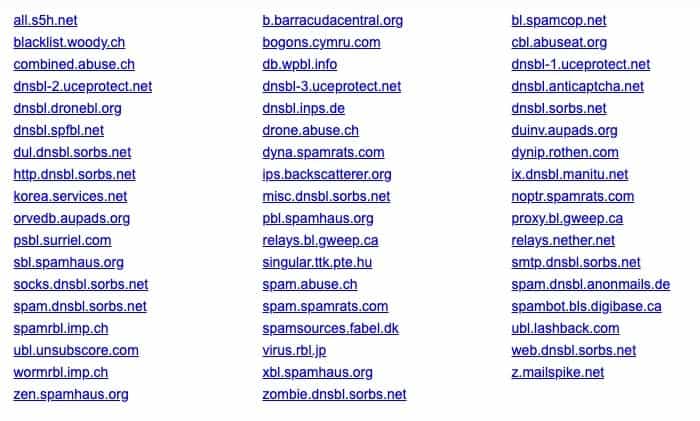
A collection of black lists on the Internet. Source: Screenshot dnsbl.info If you want to check whether a domain is affected by a blacklisting, you can check this under mxtoolbox.com. Here only the input of a domain is required. 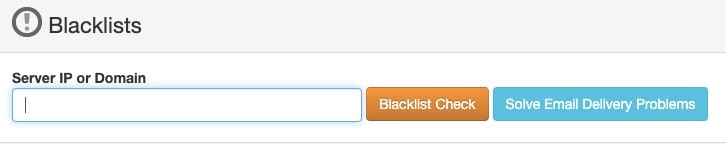
After any domain has been entered, it will be checked whether it is affected by a blacklisting. Source: Screenshot mxtoolbox.com After a few seconds the individual databases were queried and the result is displayed. In the best case the domain does not appear in any list. The error is then somewhere else. 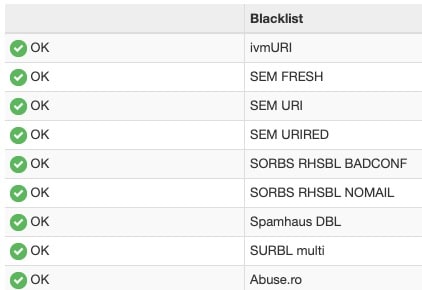 However, if the result is positive, the chances are that you will not be able to get off this list with your own strength. Consider changing your hoster. Then your IP address will change. You can monitor the number of spam mails sent on so-called live maps. You should definitely find out the reasons for the blacklisting. If the problem persists, even after you have changed hosters, your IP address will be affected again. If you have had problems with the delivery accuracy of your emails for a long time, you can also switch to a larger and/or more trustworthy email provider. In contrast to blacklisting, there is also the so-called whitelisting. This certifies particularly trustworthy senders.
Monthly Threat Report
Chris Wojzechowski bewertet einmal im Monat die aktuelle Bedrohungslage aus Sicht eines Informationssicherheitsexperten. Sein 30-köpfiges Team ist näher an realen Cyberbedrohungen dran als kaum jemand sonst — mit konkreten Handlungsempfehlungen, die Sie am nächsten Morgen umsetzen können.
Bestseller-Autor (Wiley-VCH) · M.Sc. Internet-Sicherheit · Bekannt aus Handelsblatt & WamS
Zuletzt behandelt
1x im Monat · Kein Spam · Jederzeit abbestellbar · Datenschutz
Next Step
Our certified security experts will advise you on the topics covered in this article — free and without obligation.
Free · 30 minutes · No obligation

