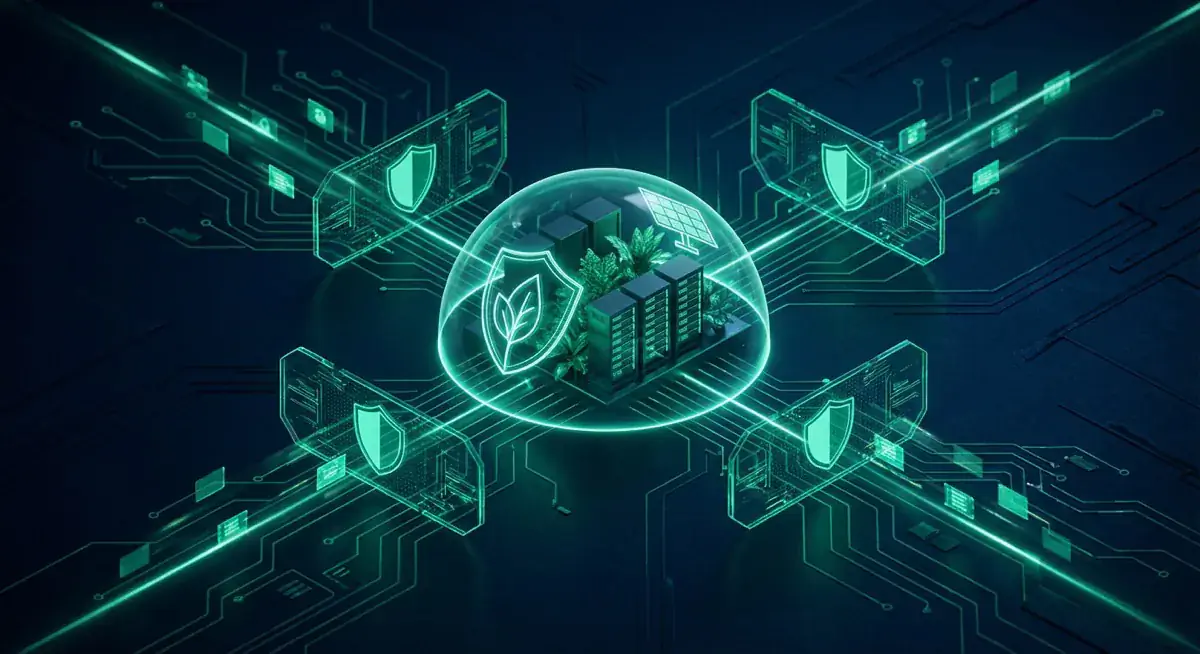
Sustainability in IT Security: Protection Meets Environment
Sustainability in IT Security: Discover energy-efficient solutions, green data centers, and future-proof strategies.
 Jan Hörnemann Chief Operating Officer · Prokurist
 TL;DR
Sustainability in IT security is a strategic necessity that goes beyond pure cost savings and addresses the ecological footprint of digital infrastructures. Data centers and security solutions like firewalls or SIEM systems consume enormous amounts of energy, leading to high CO2 emissions. Companies must expand their IT security strategy to include energy-efficient solutions to reduce operating costs and meet legal ESG criteria. For example, modern firewalls in standby mode significantly reduce power consumption. The integration of sustainable practices also strengthens reputation and positions companies as future-proof.
Table of Contents (7 sections)
Sustainability is no longer an optional goal, but a key challenge for companies across all industries. While many organizations have already adopted sustainable practices in production and logistics, one area is often overlooked: IT security. Yet sustainability plays a crucial role in IT security, as digital infrastructures and security solutions consume significant amounts of energy and resources.
At the same time, companies are under pressure to reduce their environmental footprint and comply with legal requirements regarding sustainability. The tension between security and environmental protection opens up new opportunities: through innovative technologies and energy-efficient approaches, companies can not only optimize their IT security but also make it more sustainable.
The Connection Between Sustainability and IT Security
Although the environmental challenges in the field of IT security are enormous, sustainability is often underestimated. Data centers, the heart of modern IT infrastructures, consume massive amounts of energy worldwide. Security solutions such as firewalls, SIEM systems, or encryption technologies further contribute to high energy consumption. Cloud infrastructures, which are increasingly being used in businesses, also require enormous computing capacities, further increasing energy consumption. With the steady growth of the IT security industry, this burden on the environment is becoming ever greater.
Despite these challenges, sustainability has received little attention in IT security to date. The focus is often on performance and protection, while resource efficiency is neglected. Security solutions are typically designed to ensure maximum effectiveness without taking the environmental footprint into account. Yet, especially in times of rising energy prices and growing demands for sustainability, this mindset is becoming increasingly untenable.
Sustainable IT security, however, offers companies significant advantages. It not only helps reduce operating costs but also strengthens a company’s reputation. Customers and partners increasingly expect sustainable practices, including in the digital realm. Furthermore, legal requirements such as ESG criteria (Environmental, Social, Governance) ensure that companies must extend their sustainability strategy to all areas, including IT security.
The connection between sustainability and IT security is therefore not only an environmental necessity but also an economic strategic advantage. Companies that integrate this aspect into their security strategy early on position themselves not only as more environmentally conscious but also as more future-proof.
Energy-Efficient Security Solutions: A First Step
Sustainability in IT security begins with the choice of energy-efficient security solutions. But what does that mean in concrete terms? It involves using technologies and systems that consume less energy without compromising security. Modern solutions are increasingly being developed to optimize their computing power and thereby minimize energy consumption. The goal is to combine powerful IT security with a smaller environmental footprint.
Some providers are already relying on resource-efficient technologies. For example, there are firewalls that significantly reduce power consumption in standby mode, or SIEM solutions that require less computing capacity thanks to efficient data processing. Specially developed hardware also contributes to energy efficiency: devices designed for high performance with low energy consumption make it easier for companies to achieve their sustainability goals.
The benefits for companies are clear: energy-efficient security solutions lower energy costs while simultaneously reducing the carbon footprint. They make it possible to maintain the same or even higher security standards while operating in a more environmentally friendly manner. This first step toward sustainability in IT security demonstrates that efficiency and security need not be at odds with one another but can go hand in hand. Companies that rely on such technologies not only save costs but also position themselves as responsible pioneers in the industry.
The Environmental Footprint of IT Systems
IT systems play a central role, yet their environmental footprint is often underestimated. Data centers, which serve as the backbone of modern IT infrastructures, are among the world’s largest energy consumers. (https://www.bmk.gv.at/themen/energie/effizienz/rechenzentren.html) The immense power requirements for operation and the associated cooling needs result in significant CO₂ emissions. At the same time, the disposal of obsolete hardware poses a growing challenge. Old servers, routers, or end devices often contain environmentally harmful materials and are not always recycled properly, which further increases the burden on the environment.
However, sustainability in IT security offers approaches to significantly reduce this footprint. One key lies in the implementation of energy-efficient network architectures. By using technologies specifically designed to operate with less energy, companies can utilize their resources more efficiently. Furthermore, virtualization plays a crucial role. By consolidating physical systems and migrating them to virtual machines, energy consumption can be significantly reduced. This strategy enables companies to distribute multiple tasks across fewer hardware resources, thereby maximizing utilization and optimizing operations.
Another approach is to avoid oversized systems. Many companies invest in hardware that far exceeds their actual needs, leading to unnecessary energy consumption. A precise needs analysis helps implement systems that are optimally tailored to real-world requirements.
Sustainability in IT security means not only designing security solutions more efficiently but also making the entire operation more environmentally friendly. Companies that align their IT systems with these principles not only contribute to environmental protection but also benefit from significant cost savings and improved public perception. The ecological footprint can thus be reduced step by step without compromising performance.
7 Challenges Posed by IT Systems
1 Electronic waste2 Energy consumption3 Resource consumption in hardware production4 Cooling and water consumption5 Dependence on non-renewable energy6 Software and hardware obsolescence7 Data storage and carbon footprint
Green data centers and sustainable technologies
Green data centers are characterized by the use of renewable energy, optimized hardware, and innovative cooling systems. Instead of relying on conventional power sources, they use solar, wind, and hydroelectric power to make operations climate-friendly. Efficient cooling, for example through the use of liquid cooling or leveraging natural ambient temperatures, also helps reduce energy consumption. At the same time, green data centers rely on technologies that do not let waste heat go to waste but instead feed it into local heating systems, for instance.
Companies can benefit from these approaches through targeted measures. Selecting cloud providers that operate in a climate-neutral manner is a first step. Many large providers are investing in green energy and optimizing their infrastructure to combine sustainability with performance. For companies that operate their own data centers, it is worth looking into sustainable technologies: efficient servers, modular hardware designs, and optimized room cooling can significantly reduce the environmental footprint.
Technological innovations also play a key role in enhancing sustainability in IT security. Carbon-neutral software solutions are designed for energy efficiency and minimize resource consumption without compromising functionality. Low-power devices, specifically developed for energy-constrained environments, are another example of how hardware and sustainability can go hand in hand.
Sustainability in IT security means that companies not only maintain their security standards but implement them in a way that makes sense both ecologically and economically. Green data centers and sustainable technologies demonstrate how this can be achieved, while simultaneously creating a competitive advantage for companies that invest in an environmentally conscious IT infrastructure.
Balancing Sustainability and Security
Sustainability in IT security is often viewed as a challenge, as it appears at first glance to contradict the goal of maximum security. The notion that resource-efficient technologies could inevitably lead to performance losses deters many companies from integrating sustainable solutions into their IT security strategies. In reality, however, it is clear that sustainability and security are not opposites, but can complement each other perfectly.
The solution lies in combining energy-efficient technologies with high-performance security solutions. Modern firewalls, SIEM systems, and encryption technologies have been further developed to meet the highest security standards while operating in a resource-efficient manner. The development of security strategies specifically aimed at reducing energy consumption demonstrates that companies do not have to choose between security and sustainability. Rather, they can achieve both through smart technologies and a well-designed architecture.
One example of this is companies that have significantly reduced both their operating costs and their environmental impact by implementing energy-efficient security solutions. A global IT service provider was able to reduce energy costs by 30% while simultaneously raising security standards by using carbon-neutral data centers and virtualizing its systems. Similarly, the use of low-power devices proved effective in a medium-sized company, which was able to not only reduce its environmental footprint but also optimize operational security.
Sustainability in IT security is therefore not a compromise, but an opportunity. Companies that use resource-efficient technologies can not only maintain their security standards but also simultaneously increase the cost-effectiveness and environmental friendliness of their IT infrastructure. Striking a balance between security and sustainability is not only possible but also forward-looking for a resilient and responsible IT strategy.
Consulting on Sustainable IT Security
Companies face the challenge of maintaining security standards while simultaneously reducing their environmental footprint. However, assessing which measures improve both sustainability and security is often anything but simple. External consulting offers valuable support here by providing expertise and tailored solutions.
Consulting on sustainable IT security focuses on three key areas. First, it supports companies in selecting security solutions that are resource-efficient yet powerful. This includes identifying energy-efficient technologies. Second, the consulting helps with the implementation of energy-efficient infrastructures, for example through the introduction of green data centers, the virtualization of systems, or the optimization of existing networks. Third, it includes training employees to raise awareness of resource-efficient IT practices. After all, even the most efficient technology only delivers the desired results when used correctly.
Practical examples demonstrate how effective such consulting projects can be. A medium-sized company in the manufacturing sector reduced its energy consumption by 25% by introducing sustainable security solutions and redesigning its network architecture. At the same time, it was able to significantly reduce security risks through employee training significantly reduce security risks by raising awareness of phishing attacks and other threats. Another example is an international financial institution that, with the help of external consulting, converted its data centers to renewable energy and halved the number of physical servers through virtualization.
Consulting on sustainable IT security is thus not only a way to achieve environmental and cost goals, but also an investment in the company’s future viability. With the right support, companies can effectively implement sustainability in IT security and thus take a leading role in an increasingly environmentally conscious economy.
Checklist
 #### Save Energy
-
Optimize hardware: Use energy-efficient servers, firewalls, and network technology
-
Utilize virtualization: Reduce the number of physical devices through cloud and virtualization solutions.
-
Review power sources: Switch IT infrastructure to renewable energy.
 #### Minimizing electronic waste
 -
Use devices longer: Extend hardware lifecycles through upgrades and repairs
-
Implement recycling programs: Have old devices recycled by certified providers.
-
Explore second-hand options: Buy or sell reusable IT devices.
 #### Reduce resource consumption
 -
Procure sustainable hardware: Purchase devices from manufacturers with sustainable production standards.
-
Paperless IT: Digitize IT security documentation and promote paperless processes.
 #### Use security software efficiently
 -
Consolidate software: Avoid redundant security solutions to save computing power.
-
Use automation: Run energy-intensive processes such as backups and scans outside of peak hours.
 #### Improve data management
 -
Clean up data: Regularly delete unnecessary data and backups to reduce storage consumption.
-
Data locality: Store data in energy-efficient, regional data centers.
 #### Raise employee awareness
 -
Conduct training: Inform employees about sustainable IT security practices.
-
Promote Green IT: Integrate sustainability into the company’s IT strategy.
 #### Measure sustainability
 -
Determine carbon footprint: Measure the environmental impact of your IT infrastructure.
-
Define KPIs: Set sustainability goals for IT security and operations.
 #### Review partners and providers
 -
Choose sustainable service providers: Give preference to providers that use climate-neutral data centers.
-
Demand transparency: Ask about the carbon footprint of IT security products and services.
Sustainability in IT Security as a Competitive Advantage
The importance of sustainable IT security will continue to grow in the future. With rising demands for energy efficiency and pressure to reduce the carbon footprint, sustainability is becoming an indispensable component of modern security strategies. Companies that embrace sustainable solutions early on position themselves as pioneers in an increasingly environmentally conscious economy, thereby securing a decisive competitive advantage.
The path to greater sustainability in IT security begins with a detailed analysis of the ecological footprint and the identification of opportunities for optimization. Companies should act now to integrate sustainable solutions into their IT and security infrastructure. The combination of environmental responsibility, economic benefits, and cutting-edge technology makes sustainability in IT security the strategy of the future. Take the first step and make your IT security resource-efficient and future-proof!

Monthly Threat Report
Chris Wojzechowski bewertet einmal im Monat die aktuelle Bedrohungslage aus Sicht eines Informationssicherheitsexperten. Sein 30-köpfiges Team ist näher an realen Cyberbedrohungen dran als kaum jemand sonst - mit konkreten Handlungsempfehlungen, die Sie am nächsten Morgen umsetzen können.
Bestseller-Autor (Wiley-VCH) · M.Sc. Internet-Sicherheit · Bekannt aus Handelsblatt & WamS
Zuletzt behandelt
1x im Monat · Kein Spam · Jederzeit abbestellbar · Datenschutz
Next Step
Our certified security experts will advise you on the topics covered in this article — free and without obligation.
Free · 30 minutes · No obligation

