EU Regulation | AI Governance
EU AI Act: Cybersecurity Requirements for AI Systems.
The EU AI Act (Regulation EU 2024/1689) is the world's first binding AI law. It classifies AI systems by risk, mandates cybersecurity measures, and imposes fines of up to EUR 35 million. It applies to any company placing AI on the EU market - regardless of where the company is based.
Last updated: March 2026 - reviewed by certified experts
- Prohibited practices in force
- Feb. 2025
- Maximum fine
- 35 M EUR
- High-Risk obligations (Annex III)
- Dec. 2027
- From minimal to prohibited
- 4 risk classes
Overview
What is the EU AI Act?
The EU AI Act (Regulation EU 2024/1689) is the world's first binding AI regulation. The regulation was published in the Official Journal of the EU on 13 June 2024 and applies directly in all EU member states - without national implementing legislation.
The AI Act follows a risk-based regulatory model: the higher the potential harm of an AI system, the stricter the requirements. Particularly relevant for cybersecurity are the requirements on robustness and resilience under Art. 15, and the obligation to conduct adversarial testing (red teaming) for GPAI models with systemic risk under Art. 55.
The AI Act has extraterritorial reach: it applies to any provider placing an AI system on the EU market, regardless of where the provider is headquartered. This makes it relevant for companies in the US, UK, Asia and beyond.
EU AI Act at a Glance
- EU Regulation
- EU 2024/1689, 13 June 2024
- Bans from
- 2 February 2025
- GPAI rules from
- 2 August 2025
- High-Risk from
- 2 December 2027Annex I: 2 August 2028
- DE Authority
- Bundesnetzagentur + BSI (Cyber)
- Max. fine
- EUR 35 M / 7% global turnover
High-Risk deadline approaching
Providers of high-risk AI systems must fulfil all conformity obligations by December 2027 (Digital Omnibus Regulation (EU) 2026/1744) - conformity assessment, CE marking, EU database registration.
Risk-Based Approach
The 4 Risk Classes of the AI Act
The AI Act classifies AI systems by their risk potential. The higher the risk class, the stricter the requirements - from no obligations to a complete prohibition. The classification determines which cybersecurity and compliance measures you need to take.
AI systems posing unacceptable risks, fully prohibited as of 02 February 2025.
- Social scoring by public authorities or private entities
- Emotion recognition in the workplace and educational institutions
- Biometric categorisation to infer sensitive characteristics
- Manipulation of unconscious behaviour (subliminal techniques)
- Real-time remote biometric identification in public spaces (exceptions for law enforcement)
- Exploitation of vulnerabilities of specific groups

AI systems listed in Annex III with extensive obligations from 02 December 2027; product-integrated Annex I systems from 02 August 2028 (Art. 113 AI Act as amended by Regulation (EU) 2026/1744).
- Credit scoring and creditworthiness assessment
- HR systems: recruitment and promotion decisions
- Biometric identification and categorisation
- Critical infrastructure operation: power, water, gas networks
- Law enforcement, border control, justice
- Education and vocational training
- Migration and asylum
Transparency obligations: users must know they are interacting with an AI system.
- Chatbots and conversational AI systems
- Deepfakes and AI-generated content (labelling required)
- Emotion recognition systems (outside prohibited areas)
No specific obligations - voluntary codes of conduct recommended.
- Spam filters and email classification
- Recommendation systems (without significant risks)
- AI in video games
- Simple image-processing applications
Which risk class applies to your AI system?
The classification determines your compliance effort. AWARE7 assesses your AI systems definitively and creates an action plan based on your specific risk class.
Art. 15 AI Act
Cybersecurity Obligations for AI Systems
Art. 15 AI Act requires providers of high-risk AI systems to ensure robustness, resilience and cybersecurity. The requirements apply throughout the entire lifecycle - from development to decommissioning.
Robustness against Adversarial Attacks
High-risk AI systems must be resilient against hostile manipulation (Art. 15(1) AI Act). This includes robustness tests against adversarial examples, data poisoning and model inversion. Technical measures must be documented throughout the entire lifecycle.
AI Penetration TestingData Integrity and Data Quality
Training, validation and test datasets must be appropriate in terms of errors, completeness, representativeness and statistical properties (Art. 10 AI Act). Data governance processes and bias checks are mandatory.
Technical Documentation and Logging
Complete recording of all relevant events throughout the entire operational period (Art. 12 AI Act). Logs must enable traceability and comprehensibility of the AI system - for audits, authorities and law enforcement.
Security ConsultingHuman Oversight
High-risk AI systems must be designed so that natural persons can effectively monitor outputs (Art. 14 AI Act). Human-in-the-Loop or Human-on-the-Loop - depending on the risk profile. Override mechanisms must be technically embedded.
Accuracy, Precision and Bias Testing
AI systems must be operated with appropriate accuracy, robustness and cybersecurity throughout their entire lifecycle (Art. 15 AI Act). Regular bias tests and performance monitoring are mandatory, especially for systems making decisions about individuals.
AI Security TestingConformity Assessment and Registration
Providers of high-risk AI systems must conduct a conformity assessment before placing on the market (Art. 43 AI Act) and register the system in the EU database (Art. 49 AI Act). CE marking is required.
Incident Reporting to Authorities
Serious incidents and malfunctions of high-risk AI systems must be reported to the competent national market surveillance authority (Art. 73 AI Act). In Germany this will likely be the Federal Network Agency (Bundesnetzagentur) in coordination with the BSI.
Red Teaming for GPAI Models
Providers of general-purpose AI (GPAI) models with systemic risk must conduct adversarial testing (Art. 55 AI Act). Red-teaming tests uncover security vulnerabilities, abuse potential and undesirable behaviour.
Red Teaming for AINote: The AI Act's cybersecurity requirements for high-risk Annex III systems apply from December 2027 (Digital Omnibus Regulation (EU) 2026/1744). Providers of GPAI models with systemic risk must be able to demonstrate adversarial red teaming from August 2025 (Art. 55 AI Act). AWARE7 recommends starting preparation immediately.
Art. 50 AI Act
Labelling AI content: the EU icons for AI-generated content
The transparency obligations of Art. 50 AI Act have applied since 2 August 2026. Deployers of generative AI systems must disclose two types of content: deep fakes - AI-generated or AI-manipulated image, audio or video content that resembles existing persons, objects, places or events and would falsely appear authentic or truthful - and AI-generated or AI-manipulated text published to inform the public on matters of public interest - unless it has undergone human review and a natural or legal person holds editorial responsibility. To support this disclosure, the European Commission published a freely usable icon set in 2026 as part of Section 2 of the Code of Practice on marking and labelling of AI-generated content.
Basic "AI" icon
When AI was involved in creating deep fake content or published text and a custom text label or an interactive second layer provides the details.
Example
A deep fake video with the text label "voices generated with" followed by the icon
"AI Generated"
When the content is fully generated by AI - with no human-created elements and no human editorial control apart from prompting.
Example
Fully AI-generated deep fake videos, AI-composed music, AI-generated news summaries
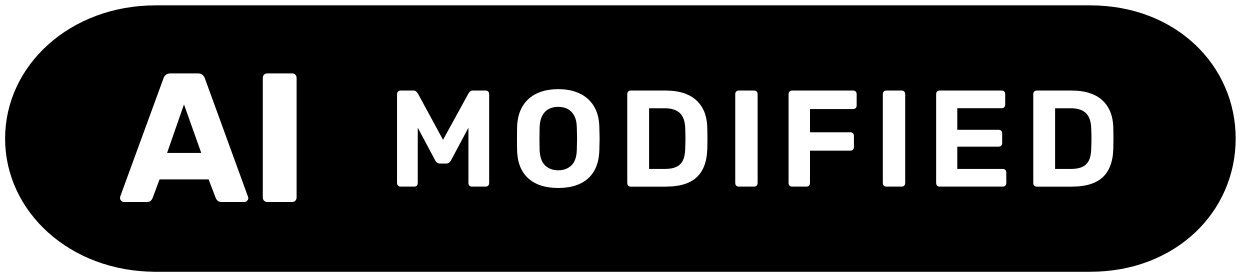
"AI Modified"
When pre-existing, human-made content was partially modified with AI, turning it into a deep fake or text on matters of public interest.
Example
A face in an authentic photograph is swapped with another person's face using AI
Exceptions and reduced obligations
- Editorial responsibility: AI-generated text is exempt when both conditions are met: it has undergone human review or editorial control, and a person or organisation holds editorial responsibility for its publication.
- Art and satire: not a full exemption - for deep fakes in evidently artistic, creative, satirical or fictional works, the obligation is limited to an appropriate disclosure that does not hamper the display or enjoyment of the work.
- No deep fakes: illustrative AI images that do not make existing persons, objects, places or events falsely appear authentic do not fall under Art. 50(4).
- Law enforcement: use authorised by law to detect, prevent, investigate or prosecute criminal offences is exempt.
Placement rules for the icons
Art. 50(5) AI Act legally requires clear, distinguishable and accessible information at the latest at the time of first exposure. The following detailed rules come from Section 2 of the Code of Practice and bind its signatories:
- Clearly perceivable and distinguishable at the latest at the time of first exposure, with no intervening overlay elements.
- Directly embedded into the content (except for creative works), unless equivalent alternatives such as a user interface overlay are available - the label must remain visible when content is reshared or downloaded.
- Accessible: clearly visible size, plain language in accompanying labels, alt text or ARIA labels for assistive technologies.
- Time-limited disclosures must remain visible long enough to be read and understood.
Important: using the EU icons is optional - the labelling obligation under Art. 50(4) AI Act is not. The icon alone does not establish legal compliance; deployers remain responsible for ensuring that their disclosure meets the legal requirements. Separate from this, providers of generative AI systems must mark their outputs in a machine-readable format (Art. 50(2) AI Act). The icons are available for download as SVG and PNG from the European Commission (as of 20 July 2026).
Regulatory Landscape
AI Act + NIS-2 + GDPR + CRA: The Full Regulatory Picture
For companies deploying AI, a complex interplay of several EU frameworks arises. All must be observed in parallel - there is no choice.
EU AI Act
Risk classes, robustness, red teaming, logging, human oversight. AI-specific regulation.
NIS-2 Directive
Cybersecurity of the entire infrastructure including AI systems. Applies to affected sectors across the EU.
NIS-2 GuideGDPR
Data protection for AI systems processing personal data. Applies to virtually all AI applications.
GDPR GuideCyber Resilience Act (CRA)
Cybersecurity requirements for products with digital elements - includes embedded AI.
CRA GuideNote for non-EU companies: The AI Act applies to any provider placing AI on the EU market regardless of their location - similar to the GDPR's extraterritorial reach. Importers and distributors in the EU share responsibility for the compliance of the AI systems they market.
Case Studies
Real AI Incidents: What the AI Act Would Have Prevented
These cases demonstrate why the AI Act is necessary - and what consequences uncontrolled AI deployment can bring. Under the AI Act, many of these incidents would have been regulatorily addressed or prevented.
ChatGPT & GDPR - Data Leak at OpenAI
March 2023OpenAI reported a bug in the open-source Redis library that allowed users to see the chat titles of other users. Italy's data protection authority Garante imposed a temporary ban on ChatGPT and initiated proceedings for GDPR violations. The incident illustrates that AI systems are not closed systems - data leaks can arise from unexpected dependencies.
Clearview AI - Biometric Data Without Consent
Ongoing since 2022US AI provider Clearview AI was fined by several EU data protection authorities (France: EUR 20 million, Italy: EUR 20 million, Greece: EUR 20 million). Clearview had scraped biometric data from the internet without the consent of those affected. Under the AI Act, this practice would be classified as prohibited biometric categorisation.
Amazon HR AI - Discrimination in Hiring
October 2018Amazon's internal AI recruitment system systematically favoured male candidates because it was trained on historically male-dominated hiring data. Amazon discontinued the project. Under the AI Act, such an HR system would be classified as high-risk and would have required extensive bias tests and human oversight - before deployment.
Tesla Autopilot - Regulatory Investigations
Ongoing since 2021US regulator NHTSA investigated over 750 accidents connected to Tesla's Autopilot system. In the EU, autonomous driving systems would be classified as high-risk AI (Annex III, transport). The AI Act requires providers to carry out extensive conformity assessments, log every incident and conduct regular safety reviews.
Advisory Services
How AWARE7 Supports AI Act Compliance
From risk classification to adversarial testing - AWARE7 guides you through all AI Act requirements with a focus on technical cybersecurity.
AI Penetration Testing & Red Teaming
Adversarial testing of your AI systems: adversarial examples, data poisoning, model extraction, prompt injection - in line with Art. 15 and Art. 55 AI Act.
Request AI pentestAI Act Gap Analysis & Classification
Definitive risk classification of your AI systems, gap analysis against all AI Act requirements, prioritised action plan with timeline.
Start gap analysisIntegrated Compliance: AI Act + NIS-2 + GDPR
Holistic advice combining AI Act, NIS-2 and GDPR in a single engagement - rather than three parallel projects.
Understand NIS-2 interaction„The EU AI Act is not abstract regulation - it has concrete cybersecurity requirements that demand technical expertise. Anyone deploying AI in safety-critical domains needs adversarial testing, not just legal advice.“
Chris Wojzechowski
Auditor with additional audit procedure competence (Section 8a BSIG) · AWARE7 GmbH
FAQ
Frequently Asked Questions about the EU AI Act
The most important questions about the EU AI Act - answered with technical depth and practical focus.
When does the EU AI Act apply?
Which AI systems are classified as "high-risk" under the AI Act?
What does the AI Act mean for companies using AI tools such as ChatGPT?
How high are the fines under the EU AI Act?
What is a GPAI model and what obligations apply?
How do the AI Act, GDPR and NIS-2 interact?
What is BSI AIC4 and how does it relate to the AI Act?
Do I need to register my AI systems in an EU database?
How does an AI security assessment at AWARE7 work?
Does the AI Act also apply to AI systems developed outside the EU?
Which AI-generated content must be labelled under Art. 50 AI Act?
What are the EU icons for labelling AI-generated content?
Aus dem Blog
Weiterführende Artikel
KI-Cyberangriffe: Deepfakes, AI-Phishing und automatisierte Exploits
KI-gestützte Angriffe: Deepfake-Audio für BEC, LLM-Spear-Phishing und AI-Malware - Erkennungsmethoden und Integration in die Security-Strategie.
LLM Security: Prompt Injection, Jailbreaking und KI-Red-Teaming
LLM Red Teaming: Prompt Injection, Jailbreaking, Training-Data-Poisoning und OWASP Top 10 for LLM Applications - mit Defense-Strategien.
GDPiRate: Seitenkanalangriff deckt DSGVO-Sicherheitslücken auf!
Seit Mai 2018 haben Nutzer das Recht online auf persönliche Daten zuzugreifen. Drei Studien decken nun DSGVO-Sicherheitslücken auf.
Schedule an AI Security Assessment
In a free 30-minute call, we analyse your AI systems, determine the relevant risk class under the AI Act, and show which cybersecurity measures are specifically required - with a timeline and fixed-price proposal.
Kostenlos · 30 Minuten · Unverbindlich